
Racing Post: Janus

WHAT WAS IT?
Racing Post is the UK's Horse and Dog Racing "Bible" - the go-to place for deep insight and data. The aim of this project was to overhaul their B2C (and eventually their B2B) product lines to become the aggregators of all Horse Racing & Sports Bettor needs within the UK and beyond. This would drive growth across 5 customer related and 2 technology goals, raising engagement levels, betting revenue and subscription uptake. The first customer facing product to be released was the app – it was the top revenue generator and the best platform to reach a larger swathe of the audience.
WHY WAS IT NEEDED?
The Racing Post's digital product line had declining revenue, a frustrated and limited editorial team, slow product development cycles, and new users bouncing at a high rate because they could not understand what was in front of them. Also, the site and apps were slow to load because the code base was utter "spaghetti" as was the user experience, the editorial CMS was from the Mesozoic Era, the recent rebrand hadn't been fully implemented and no one had properly talked to the customers for years. Something had to give. The company finally focused and invested. On came Project Janus...
Outcomes
The iOS app released first, then the Android app 2 months later, some revised web areas 3 months later
Commercial impact
- In app conversion / betting revenue increased over 10%.
- News pages consumed up by 2.6 pages per session.
- Customer satisfaction scores increased from 3.1 to 4.5 (out of five) within 3 months; scores were always high with new and younger app users, long time customer ratings steadily rose.
- Increased customer diversification, attracting more growth market and midlevel users - groups that could be better monetised.
Organisational impact
- More formalised and accountable processes for agreeing on business and user needs, briefing teams, gaining user insight, and handing over information and assets between departments.
- Design and research became seen as crucial problem solvers and strategic partners for initiatives across the business.
- New structures and opportunities for advancement in product, UXRD, tech and leadership resulted from the length and depth of this project.
MY ROLE IN THIS PROJECT
Director of Product Design and User Research +
de-facto Programme Manager
I was charged with overhauling the process of how product discovery, customer feedback collection and design solutions were tackled within the company; a company with low UX maturity and no standard processes for delivery large projects that involved nearly every department in the company. Beyond operations, my main task was changing how the business interacted with design and research, balancing user feedback along with internal subject matter expertise and commercial opportunities / constraints when problem solving for three different product platforms simultaneously...
My role involved:
- Lots of operational set-up or re-configuring for this size of project
- Guiding and flexing research strategy
- Creating / curating design vision across iOS, Android and web
- Coordinating multi-disciplinary teams to share knowledge and assets
- Cross-departmental relationship building
- Extensive collaboration and consultation with the Senior Leadership Team as this massive project progressed.
Core team I led or collaborated with:
- B2C product designers
- User researchers
- Product analytics
- B2C product management
- Tech delivery managers
- Development leads for web, app and database
Senior leadership-level collaborators:
- CEO
- Director of Racing
- CPO
- CTO
- Editor in Chief
- P&L owners
CUSTOMER NEEDS DRIVING COMMERCIAL OUTCOMES
Bringing the customer experience into the project priorities
Users needed to be involved.
The UX and feature sets on the apps and web had become bloated and complex. We needed user insights to gage why users stopped using our digital products, how the Racing Post fit into their racing and betting routine, and what opportunities could we grasp in this product overhaul.
The visuals and functionality needed to be modernised, refreshed, rebranded.
Users' called the apps and website "old fashioned", "fiddly" and "clunky". Customers liked them for the data and little else. Racing Post risked being left behind as flashier, easier-to-use racing apps came out.
The product needed to meet basic accessibility standards.
Most of the current core audience skewed older, over 55 on web specifically. We aimed for WCAG AA to widen our customer base and ease usage frustration.
We needed to engage our growth audience, not just core users.
Our core base was very engaged but very hard to monetise consistently - they had their established routines. Racing Post needed to attract customers still learning about racing and betting.
KICKING IT ALL OFF:
Getting agreement on strategy, outcomes, and larger processes.
The key part of my role, along with the Head of B2C Product was to get agreement with the Senior Leadership team, specifically the Director of Racing, the CEO, CTO, CPO and the Editor in Chief , on what good user, business, and commercial metrics looked like within the budgets / timelines.
Building the trust internally so the customer voice could be heard.
At the start of this project, UX maturity within the organisation was low and outside of occasional marketing surveys and "tweet storms", the customer voice was silent.
- I implemented a design sprint routine to aid with both of these issues, and more.
- By doing structured, scheduled, transparent design sprints, we were able to do customer and product discovery at pace and keep relevant stakeholders and collaborators in the loop, get through a mountain of scope AND truly bring the voice of the customer to the ALL of the company - often quite literally.
- In the sprint process, I worked with the research team to get in front of research needed for upcoming sprints and advised how to keep stakeholders in the loop on user testing viewing sessions. Refining research's process fundamentally changed how the business worked with the UXDR team, building trust of its expertise and bringing customer insights that had positive impacts for all departments.


KEY CUSTOMER INSIGHTS
These insights direct impacted prioritisation of services, products and features across the company

Highly knowledgeable racing enthusiasts + experienced bettors
Most likely to:
- Buy the physical newspaper
- Buy a digital subscription
- Bet directly with their preferred bookmaker instead of through Racing Post's integrated betting

Growing racing knowledge, betting on big swings (time poor)
Most likely to:
- Consider signing up to an affiliate offer
- Bet with their bookmaker through Racing Post if it's easy and there are offers available
- Follow and value Racing Post tipping and insights

Novices and newbies to racing and betting
Most likely to:
- Consider signing up to an affiliate offer and betting through Racing Post's integrated betting
- Follow and value Racing Post tipping and insights
- Consume video, audio and social content
SERVICE MAPPING: FROM TRACK TO APP
For both complexity and proprietary reasons, I cannot show the final service map, but I can speak to what it covered:
New features that needed to be coordinated across internal and external channels
New features and product like Smart View needed to pull from the internal data bases and be designed to work across app, web, kiosk, large display and the newspaper - each optimised for both B2C and B2B2C contexts.
Aligning and future-proofing subscription and related content structures
Coordinating with commercial, B2B, editorial, product and customer service on how to best align revenue objectives with commercial contracts and contextual customer experiences on the track and in digital.
Coordinating track and bookmaker print assets with live data changes in digital
Working with editorial, B2B2C, PR, and product on messaging, design and distribution schedules of both print assets and digital data to reduce customer confusion when switching between the two.
Integrating Customer Service into the customer journey and product process
Creating new ways of working throughout the company to get both customer service and user research more visibility and strategic importance, helping to make Racing Post more customer centric throughout.
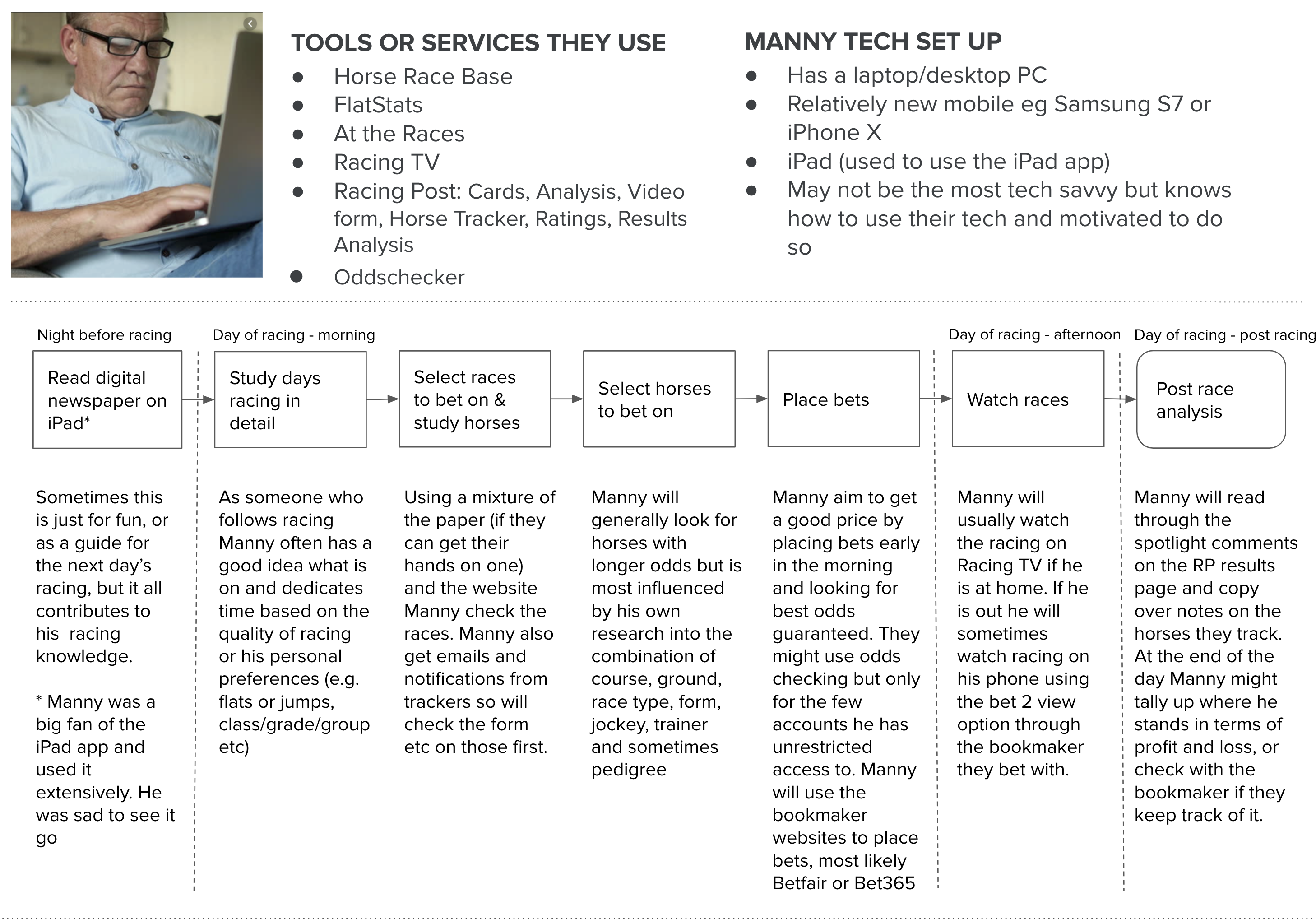
Mapping out the complete user betting process, including competitor usage
Putting together a complete user journey, informed heavily by user research, that included all of the process, tools and info users gathered to make a bet. It showed how Racing Post was used amongst competitors.
BEYOND PRODUCT: WORKING WITH EDITORIAL
The news and editorial side of the business was finally, after many long years, upgrading their extremely restrictive CMS. Transforming how news content would work in the Janus products meant editorial content could get a long overdue visual refresh. Editorial also wanted, needed, demanded more flexibility and features for how content could be presented on the website and in the apps. This led to changes in content taxonomy and the design of many variations of content presentation including:
- Highlighting breaking news, video and audio content
- Visually indicating which content needed a subscription
- Dynamic data modules integrated into related articles
- Differentiation between editorial feature content vs tipping and analysis
- Highlighting racing festivals and related events
- Live commentary feeds and social media integrations
- Sponsored editorial and affiliate partner promotion
- And all the states of each: bylines, date/time of publication, sharing, popularity, etc.
A massive project all in itself, crammed into the same timeline. It only worked due to the good working relationships built between product management, design, research and Editorial, and the trust built between the teams.


More editorial-focused product and design improvements:
KEY HIGHLIGHTS AND FEATURES

A home screen focused on breadth of content, dynamism and timeliness.
More flexibility for News & Editorial with more modules, more layouts
A cleaner, more inclusive, more Racing Post promoting racecard
Helping onboard new racing users with better labelling and visuals

Tying deep racing data to timely racing, tipping and betting.
Using e-commerce logic to improve integrated betting flows.
New tools, new access, easier ways to place bets once in the bet slip.
Easier, cleaner, context relevant entry points and benefits for subscription.

And, of course, a new UI design system
Benefits of this design system being created:
- Roughly 40% less design time needed for layouts and features
- Roughly 48% less dev time needed for front end UI implementation*
- 98% of visual UI WCAG AA accessible (the last 2% being racing industry specific assets we could not change)
- Fully rebranded, flexible, reusable UI interface and UX pattern library**, helping with overall brand consistency and reduction in asset duplication across departments (these assets were later used in B2B products, eCRM and other digital properties)
* While designing and building this design system, we worked with development to create de-facto UI tokens (this was before Figma offered this functionality)
** This design system was built to work in REACT, which enabled a more universal design for over 90% of elements and components.
THE ORGANISATIONAL IMPACT
Trust and understanding between the business, editorial and product were established: The UX maturity of the business and trust in qualitative research improved drasticaly throughout the new processes introducted in this project. Establishing Design Sprints involving all relevant the teams and stakeholders helped with raising the profile of designers to "business problem solvers" and with better sharing of subject matter expertise from different disciplines across the company to all teams involved.
Proper understanding of our users: Through our pre-project user research and validation user testing sessions throughout the project, our stakeholders and subject matter experts gained a more broad, yet nuanced view of who used our products, when, how and why. This helped to break down long held assumptions and biases that had stymied product innovation.
Broader collaboration across departments within and outside of the product production track: The inclusiveness and transparency produced with the design sprint process lead to the design and research team to be first port of call for other departments looking for different or more creative way to solve their day-to-day issues, both in regards to deliverables and better processes.
Long overdue improvements to News and Editorial content handling: Some improvements launched right away and others funneled into a detailed future-state plan for design and implementation of new content templates. The upgrades gave more flexibity to the Editorial team to present more engaging content in written, photographic and video formats, as well as better cross navigation and integration of racing data and tipping.
Other Projects


Location
London, UK
Copyright
2025. All rights reserved.